

You’ve probably tried everything to eliminate fleas in your home. You bathed your pet, vacuumed the carpets, washed the bedding, and maybe bought a flea spray from the store.
A week later the fleas were back, or they never fully went away, and now you are here looking for what everyone else left out.
Setting Right Expectations for Flea Removal
What most flea removal guides do is give you the right steps in the wrong order. They don’t explain why each step works and what happens if you skip or rush any of them. People who follow those guides and still have fleas are not doing anything wrong.
Where those guides fall short is that they completely ignore the biology of fleas. And hence, they fail.
Here’s the direct uncomfortable fact that you’d need to keep in mind if you’re planning to get rid of fleas completely on your own. Total flea removal is not a weekend project. Done correctly, aggressively, safely, and with laser precision, a moderate infestation will take 6 to 10 weeks to resolve.
A heavy infestation in a large, carpeted home with pets can take four to six months.
Anyone who wants to remove fleas completely from their home is on their second or third round of treatment. And they’re certainly hitting the wall without knowing it.
The treatment is working. But they are quitting too early, or not being meticulous in the monitoring stage, because no one told them the infestation looks worse before it gets better.
Flea removal is more like a weight-loss protocol. Most people want the quick fix, but there’s no quick fix.
This post is for you who have already accepted that there is no shortcut; a full commitment is required, and who wants the complete picture so that every hour of effort actually goes somewhere. If that is you, everything below is what you need.
Why Fleas Are Hard to Remove Completely
The #1 reason for the failure of most flea treatments is not your pesticides or pets with fleas. It is a misunderstanding of where the flea population actually lives.
When you look at a flea infestation, you see adult fleas on your pet, in the carpet, or jumping on your ankles. Those visible adult fleas represent approximately 5% of the total flea population in your home.
The remaining 95% is invisible, distributed across your carpets, beds, furniture upholstery, floor crevices, and baseboards in the form of eggs, larvae, and pupae. In case of a severe infestation, they can be present in places like bathroom and basement too.
Spraying your pet and vacuuming the floor removes or kills some portion of that visible 5%. The other 95% continue developing undisturbed, and within days or weeks the adult population is back to where it started.
This is the 95/5 rule of flea removal, and understanding it changes how you approach treatment entirely.
Flea Species That Infest Homes
Nearly every home flea infestation in the United States is caused by the cat flea, Ctenocephalides felis.
Despite the name, cat fleas infest dogs, cats, and wildlife equally. They are the species behind approximately 95% of residential cases.

Female C. felis begin laying eggs within 24 to 48 hours of their first blood meal, producing 27 to 50 eggs per day while consuming about 15 times their body weight in blood daily.
Fifty untreated fleas can produce approximately one million eggs in four weeks. That number is not alarming.
It is the reproductive math that explains why a small infestation ignored for three weeks becomes a whole-house problem.
Flea Eggs and Flea Larvae – The Hidden Blockages of Flea Removal
Flea eggs are not sticky. Adult fleas lay eggs on your pet, and the eggs fall off within hours into wherever your pet rests, walks, or sleeps.
Every surface your pet touches becomes an egg deposit site. Flea eggs represent approximately 50% of the total flea population in an infested home at any given moment.

They hatch into larvae in one to ten days depending on temperature and humidity.
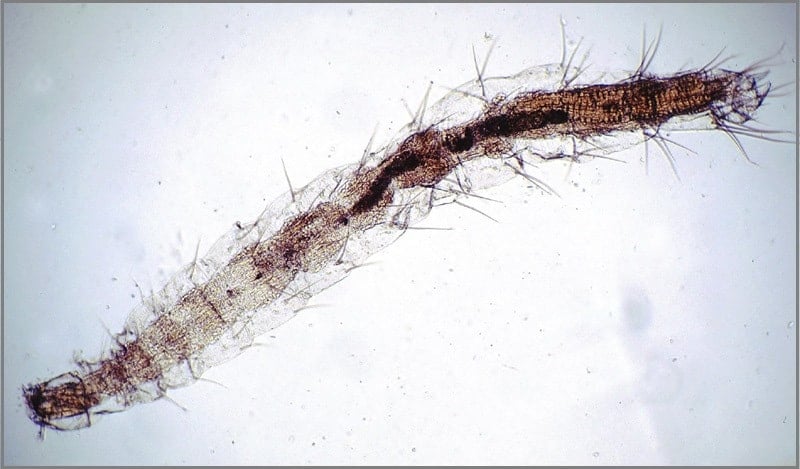
Flea larvae are small, pale, worm-like, and avoid light. They burrow deep into carpet fibers, crawl under furniture, push into floor crevices, and settle into pet bedding. There they feed on flea dirt (adult flea feces), the partially digested blood excreted by adult fleas, which accumulates wherever adult fleas feed.
Flea dirt in carpet or bedding confirms active infestation. If you want to verify that small dark specks are flea dirt rather than regular dust, place them on a damp white paper towel. Flea dirt turns red as the dried blood rehydrates.
Regular dust does not change color. Flea larvae are highly vulnerable to drying out and die when relative humidity drops below approximately 45%.
Larvae develop for five to twenty days, then spin a silk cocoon and enter the pupal stage. This is the part that makes complete flea removal so difficult.
The flea pupa inside its cocoon is completely immune to every insecticide available to consumers and most of what professional applicators use.
No spray, powder, or fogger penetrates the pupal cocoon. Environmental debris, including carpet fibers, dust, and pet hair, sticks to the sticky outer surface of the cocoon and adds a physical camouflage layer that makes cocoons nearly impossible to identify visually.
The pupa inside undergoes full metamorphosis, becomes an adult flea, and then waits. It waits for vibration, body heat, and carbon dioxide that signal a potential host is nearby. A dormant pupa can remain viable inside its cocoon for up to twelve months.
This is why homes that have been vacant for months can suddenly produce flea bites within minutes of new occupants moving in.
The only way to address the pupal stage is to apply heat directly via steam cleaning at temperatures that penetrate carpet fibers deeply enough to reach cocoons.
There is no spray that solves the pupal stage. Complete removal requires accepting this and building a treatment plan around it.
The First Rule of Flea Removal: Treat Your Pet and Home the Same Day
The most common treatment error, after incomplete environmental treatment, is treating the pet without treating the home on the same day or treating some pets but not all of them.
You must treat every pet in the household simultaneously, including cats and dogs that appear unaffected. Fleas move between hosts and lay eggs on all of them. An untreated pet sustains the infestation regardless of how thoroughly you treat every other surface in the home.
Before any pet treatment for pets, the fastest mechanical option is a flea comb. Flea combs have fine teeth that remove adult fleas from fur while allowing hair to pass through.
Flea combs are not a treatment on their own. They are an immediate population-reduction tool and a confirmation tool.
Comb from the face and neck first, then toward the tail, dipping the comb in hot soapy water between passes to drown removed fleas. The neck and the area in front of the tail are where adult fleas concentrate most heavily.
Flea shampoos kill adult fleas on your pet through direct contact. They provide immediate visible relief. They do not treat the home environment, they do not kill eggs or larvae in carpet, and they have no residual effect after rinsing.
Using flea shampoo without treating the home at the same time is the most common version of the partial treatment that fails. The pet looks better for a day or two while the 95% of the population living in your carpets continues to develop.
Shampoo is an appropriate first step when combined with simultaneous environmental treatment, not a standalone solution.
For ongoing protection, pet treatment options fall into three categories. Oral medications, which typically rely on active ingredients such as fluralaner, afoxolaner, or similar systemic compounds, kill adult fleas within hours and require a veterinarian’s prescription for the most effective formulations.
Topical spot-on treatments applied between the shoulder blades kill adult fleas and, depending on the formulation, may include insect growth regulators that stop eggs from hatching.
Products containing fipronil or imidacloprid as their primary active ingredient are among the most widely used topicals and are available over the counter in various concentrations. Flea collars vary widely in effectiveness by active ingredients.
Your veterinarian is the right person to identify which formulation is appropriate based on species, weight, age, and health status, and whether any existing health conditions affect product selection.
Flea treatments formulated for dogs can be lethally toxic to cats. Permethrin, a common active ingredient in dog flea treatments and many household sprays, is toxic to cats at any exposure level, including through contact with a recently treated dog. This is not a cautionary footnote. Permethrin toxicity is a veterinary emergency in cats.
Once your pet is treated, do not isolate it. A treated pet is the most effective flea trap in your home. Fleas emerging from pupal cocoons in response to vibration and heat will jump onto your treated pet, absorb the treatment through contact, and die within hours.
A pet confined to one room removes that trap from the areas that need it most. Let treated pets move freely through the house.
Home treatment must begin on the same day as pet treatment. Starting them on different days breaks the treatment timeline and allows developing fleas to mature past the stage you are targeting.
How to Treat Your Home Based on Where Fleas Actually Live
Flea treatment has to target the places where flea eggs, larvae, and pupae actually concentrate. Fleas do not distribute evenly through a home.
They concentrate where pets spend the most time, where larvae can find warmth, darkness, and humidity, and in the cracks and crevices where eggs and flea dirt accumulate.
Vacuuming
If there’s one tool in your home that is most underused for flea removal, it’s your vacuum cleaner.
Research from Texas A&M AgriLife Extension documents that thorough vacuuming removes approximately 60% of flea eggs and 30% of flea larvae from carpet.
Beyond those direct removals, the vibration generated by a running vacuum stimulates dormant pupae to hatch.
Those newly hatched adults emerge, jump onto your treated pet, absorb the treatment, and die. You are not just cleaning during the treatment period. You are actively triggering the insecticide-immune pupal stage into a state where it can be killed.
Vacuum all carpeted areas, upholstered furniture surfaces, mattresses, rugs, along baseboards, in crevices between floorboards, and under and behind furniture. After each session, immediately empty the canister into a sealed bag and remove it from the house.
Fleas, eggs, and larvae survive inside a vacuum and re-emerge if the contents remain in the machine. Vacuum every day throughout the active treatment period.
Steam Cleaning
Your steam cleaner provides a heat-based kill that reaches all life stages including pupae in carpet fibers. To be honest, your steam cleaner is the secret weapon for removing fleas completely from your home.
The combination of heat and moisture kills eggs, larvae, and pupae on contact without chemical exposure.
Focus on steam cleaning in areas where pets rest, along baseboards, pet beds, your bed, couches, and carpets and rugs. Focus on the soft upholstered furniture.
Steam cleaning and daily vacuuming together are substantially more effective than either method alone.
Washing Fabrics in Hot Water
All washable fabrics that pets have contact with must be washed in hot water at a minimum of 140 degrees Fahrenheit, which is 60 degrees Celsius. This temperature kills all flea life stages in fabric.
Wash pet bedding, your own bedding if pets sleep in your room, couch cushion covers, throw blankets, and any clothing stored near the floor. Repeat every two to three weeks throughout the treatment period.
Fleas can latch onto your clothes from outdoors or from infected pets and can enter your home. So, while washing, do not leave any of your clothes that you might have worn in nature or in your yard. More on it later.
IGR or Insect Growth Regulators
For carpets and upholstered surfaces that cannot be washed or steam cleaned, an insect growth regulator spray is the most important product most people never use.
IGRs are a class of compounds that do not kill adult fleas. What they do is prevent flea eggs from hatching and disrupt flea larval development, breaking the reproductive cycle at the stage responsible for replenishing the adult population.
IGRs are available as standalone sprays and as combination products that pair an IGR with an insecticide. The combination approach is more effective than either alone because the insecticide addresses the adults the IGR cannot kill.
The EPA registers IGR-containing products for residential flea control, and their safety profile for indoor use is well established.
Apply IGR-containing sprays to all carpeted surfaces, upholstered furniture, and pet resting areas following the product label for coverage and reapplication timing.
Many household flea sprays use pyrethrin, a botanical extract derived from chrysanthemum flowers, or its synthetic equivalent permethrin as the active insecticide ingredient.
Pyrethrin kills adult fleas on contact and has a low mammalian toxicity profile when used as directed.
When selecting a home spray, check the label to confirm it is safe for use around cats before applying it anywhere a cat can access.
Pyrethrin and permethrin are not interchangeable in safety for felines.
Scattering Diatomaceous Earth
Diatomaceous earth is a non-chemical option for treating carpets, floor crevices, and areas under furniture where larvae concentrate.
Food-grade diatomaceous earth kills flea larvae through physical abrasion of their outer cuticle, causing dehydration. It is not a replacement for IGR treatment, but it is a necessary supplement in areas where you prefer to avoid aerosol products.
Apply with gloves and a mask as inhaled particles are a respiratory irritant, and keep pets and children out of treated rooms until the product has settled.
Reducing indoor humidity in carpeted rooms through air conditioning or a dehumidifier during the treatment period creates an environment hostile to larval survival. Flea larvae die below approximately 45% relative humidity.
Treating Your Yard for Fleas
There’s one common thread that runs across all fleas re-infestation. People who have treated their homes and pets for fleas didn’t treat their yards.
Fleas live outdoors in warm, shaded, moist areas, and dense bushes. They concentrate wherever pets spend time because those locations accumulate the flea dirt and shed hair that larvae feed on.
Shaded spots under decks, beneath bushes, along fences, in leaf litter, and in any mulched planting bed adjacent to the house are primary outdoor flea habitats.
Sunny, open areas of lawn that dry out in direct sun are not where fleas live.
Yard treatment does not need to cover every square foot. It needs to cover the shaded areas where your pets rest and the perimeter zone directly around the house.
For outdoor chemical treatment, use a pesticide labeled for flea control and applied according to label directions. Always follow the safety protocols.
Mow the lawn before treating, which exposes larvae to sunlight and direct product contact. Remove leaf litter and debris from shaded areas before treatment.
Beneficial nematodes are a biological control option for outdoor flea larvae in soil. These microscopic worms prey on flea larvae and are applied by watering them into treated areas.
Texas A&M University notes their effectiveness is best in sandy soil with consistent moisture and has not been well tested in other soil types.
Apply in the evening or on a cloudy day to avoid UV exposure that degrades nematode survival and irrigate before and after application to help them move through soil in search of prey.
If wildlife activity is present near or in your home, yard treatment alone may be insufficient.
Raccoons, opossums, feral cats, roof rats, bats, and squirrels that nest in or near structures carry Ctenocephalides felis and can sustain an outdoor flea population indefinitely regardless of how thoroughly you treat the yard.
A pest professional can identify wildlife entry points and seal them as part of a comprehensive integrated pest management plan.
Post Flea Treatment Jitters You Are Most Likely to Get
This is the section that most people need, and most flea treatment guides miss out on.
In the first one to two weeks after the comprehensive treatment, you will likely see more adult fleas than before treatment started.
DO NOT get shocked. This is not a sign that treatment has failed. It is a sign that it is working.
The vacuuming you are doing daily is triggering dormant pupae to hatch. Those newly hatched adults are emerging, failing to find an untreated host, becoming visible as they search, and dying.
The treated pet is killing fleas that jump onto it. The pupal population that was sitting dormant in your carpets is being flushed out faster than it would have hatched on its own, which means you are compressing a process that would have taken months into a shorter and more visible burst.
The visible surge typically peaks around week two to three and then begins declining.
If you see this surge and stop treatment because you conclude it has failed, the undisturbed remainder of the pupal population will hatch, find no active treatment remaining, and the infestation will return to its previous level or worse.
Flea traps, which use a low-heat light source to attract and capture adult fleas on a sticky pad, are useful during this period not as a treatment but as a monitoring tool.
Placing one or two traps in carpeted rooms gives you a weekly count showing whether the adult population is declining.
A dropping trap count over consecutive weeks confirms treatment is working even when what you are seeing suggests otherwise.
How Long Complete Flea Removal Actually Takes
A mild infestation in a smaller home with minimal carpet, treated aggressively and consistently from the first day, can be resolved in six to eight weeks.
At that point, daily vacuuming can taper to every other day, flea trap counts should be near zero, and pets should show no signs of flea activity.
A moderate infestation in a larger carpeted home with multiple pets takes eight to twelve weeks under aggressive, consistent treatment. If any week of treatment is missed or any zone is undertreated, restart the timeline.
A heavy infestation with established flea populations across multiple rooms, plus a yard with ongoing wildlife activity, should be considered a four-to-six-month project.
A pest professional using integrated pest management methods, which combine targeted insecticide at harborage locations, IGR application, structural entry point sealing, and scheduled follow-up treatments, is appropriate at this severity level and produces better results than consumer products alone.
The CDC recommends a follow-up professional treatment seven to ten days after the initial application for moderate to severe infestations, because pupal cocoons that were dormant during the first treatment will have hatched in that window and can be killed before they breed.
Health Risks That Make Complete Flea Removal Urgent
Most people treat fleas as a nuisance problem. They are. But they are also vectors for several diseases and parasites that affect both pets and humans, and knowing what they transmit makes the case for urgency clearer than itching alone.
Murine typhus is a bacterial disease transmitted to humans when cat fleas and Oriental rat fleas deposit infected feces on the skin during a bite, which then enters through the bite wound or through scratching.
The CDC documents murine typhus as a flea-borne disease with symptoms including headache, rash, and muscle pain. It is underdiagnosed in the United States and is most common in southern states with high flea activity.
Tapeworms, specifically Dipylidium caninum, are transmitted when dogs, cats, or occasionally humans ingest a flea carrying tapeworm larvae.
Pets with flea infestations are at high risk for tapeworm infection, which produces visible rice-like segments around the tail and in feces. Most infected pets show no dramatic symptoms but experience ongoing gastrointestinal disruption.
Cat scratch disease, caused by the bacterium Bartonella henselae, is transmitted to cats via flea feces and then from cats to humans through scratches or bites. A cat does not need to be visibly ill to transmit the disease. Swollen lymph nodes, fever, and fatigue are the primary human symptoms.
Plague, caused by Yersinia pestis, is primarily associated with the rat flea rather than the cat flea, but it is worth naming because it remains present in wild rodent populations in the American West.
Ground squirrel fleas are the primary vector for transmission to humans who come into contact with infected rodents or their fleas.
Flea allergy dermatitis is the most common dermatological condition in domestic cats and dogs in the United States.
A single flea bite triggers a severe allergic reaction in sensitized animals. As few as one or two bites are enough to cause intense itching, hair loss, skin lesions, and secondary bacterial infection in an allergic pet.
Anemia from blood loss is a real risk in young animals, very small pets, or heavily infested animals of any size, as a single adult flea consumes approximately 15 times its body weight in blood daily.
If any person in the household develops an unexplained rash, fever, or swollen lymph nodes during or after a flea infestation, consult a physician and mention the flea exposure. These are treatable conditions but are commonly misdiagnosed when flea exposure is not reported.
If Your Home Has Fleas and You Have No Pets
A flea infestation without pets is confusing but not uncommon, and the explanation is almost always one of three things.
Wildlife
Wildlife nesting in or near the structure is the most common cause. Roof rats, squirrels, raccoons, opossums, bats, and feral cats that nest in an attic, crawl space, wall void, or garage carry C. felis and can sustain a flea population that migrates into living spaces.
Adult fleas readily bite humans in the absence of their preferred animal host, typically on the ankles and lower legs.
Treating the interior while the wildlife source remains active is a losing effort. Identifying and sealing the entry points that allow wildlife access to the structure is the necessary first step.
Previous Occupants
Flea pupae can remain viable for up to twelve months in an empty home. Previous tenants or owners with pets may have left behind a dormant pupal population in carpets that hatch in response to the vibration, body heat, and CO2 of new occupants. This explains why people moving into a new home sometimes experience flea bites within hours of arrival.
The treatment approach is the same as for a standard infestation, but there is no pet to treat. Focus entirely on environmental treatment through daily vacuuming, steam cleaning, and IGR application to all carpeted surfaces.
You Bring –in Fleas Inside Your Home
The third cause is human transport. Fleas attach to clothing, shoes, and bags after contact with infested grass, an infested animal, or a home with an active infestation.
This typically introduces a light population rather than an established infestation, and early aggressive environmental treatment resolves it faster than a full-cycle case.
What Fleas in Your Home Actually Telling You
A flea infestation is almost always a signal that something in the environment around your home has created conditions that sustain a flea population.
Dense ground cover close to the house, wildlife activity in the yard or structure, neighboring properties with heavy flea loads, or gaps in pet preventive treatment are the most common underlying conditions.
Eliminating the active infestation requires the weeks of consistent treatment described above. Preventing reinfestation requires identifying and changing the condition that allowed establishment in the first place.
Year-round flea preventive treatment on pets is the single most effective long-term prevention measure.
Fleas are active year-round in heated homes regardless of outdoor temperature, because central heating maintains the warmth and humidity the flea life cycle requires in every season.
A pet on continuous monthly prevention picks up individual C. felis before they can breed, preventing the population from ever reaching infestation threshold. The cycle that produces infestation never gets started.
Closing Comment
A flea infestation is not simply fleas on a pet. It is a simultaneous, self-sustaining population of eggs, larvae, pupae, and adult fleas distributed across your pet, your home, and your yard.
Treating any one of those three zones without treating the others at the same time is the single most common reason infestations persist despite genuine effort.
This page covers all three zones, in the order that matters, with the mechanism behind each step explained, so you know why it is non-negotiable.
Also, there are there things that you should never lose if you want your home to be flea-free forever. Those are patience, persistence, and closely monitoring the signs of fleas
This is an information-only guide. Please consult with a qualified pest control professional for flea removal.

We’re Mark and Jim, and we’re retired pest controllers who made homes pest-free for more than three decades. We, along with our team of experts, founded this site to give you the pest control hacks that work.